Declassified UFO / UAP Document
SOVIET TREATMENT OF PRESIDENT REAGAN SINCE NOVEMBER 1980
Ever wanted to host your own late-night paranormal radio show?
Across the Airwaves
You're on the air. Callers bring Mothman, Fresno Nightcrawlers, UFO sightings, reptilian autopsies, and whispers about AATIP and Project Blue Book. Every reply shapes how the night goes.

AI-Generated Summary
This document analyzes the fluctuations in Soviet propaganda regarding President Reagan between 1980 and 1983. It identifies two distinct periods of Soviet diplomatic restraint that were ultimately undermined by geopolitical tensions.
This intelligence assessment, dated February 3, 1984, examines the Soviet Union's rhetorical and propaganda treatment of U.S. President Ronald Reagan from his election in November 1980 through early 1983. The document posits that the tone of Soviet authoritative statements and media commentary serves as a sensitive barometer for the state of U.S.-Soviet relations. Historically, the Soviet leadership has utilized periods of restraint in public criticism to signal a desire for improved bilateral ties, often coinciding with specific political shifts in Moscow. Following Reagan's 1980 election, Soviet media initially adopted a positive tone, suggesting a potential reversal of previous tensions. However, this optimism was short-lived, giving way to low-level criticism and eventually direct attacks on the President's policies by May 1981. This critical stance persisted until the death of Leonid Brezhnev, with a brief exception during the period when the U.S. administration agreed to arms control talks in Geneva, though this was interrupted by the imposition of U.S. sanctions following martial law in Poland. A second shift occurred with the accession of Yuri Andropov, who initiated a more tentative effort to improve the climate of U.S.-Soviet relations. Soviet leaders and specialists muted their previous harsh rhetoric, expressing receptivity to improved ties. This period of selective restraint lasted until the spring of 1983, when renewed contention over INF (Intermediate-Range Nuclear Forces) deployments and other geopolitical issues caused the Soviet propaganda apparatus to revert to its previous stance.
The treatment accorded an American president in Soviet authoritative statements and media commentary is a sensitive barometer of Soviet expectations for relations with Washington.
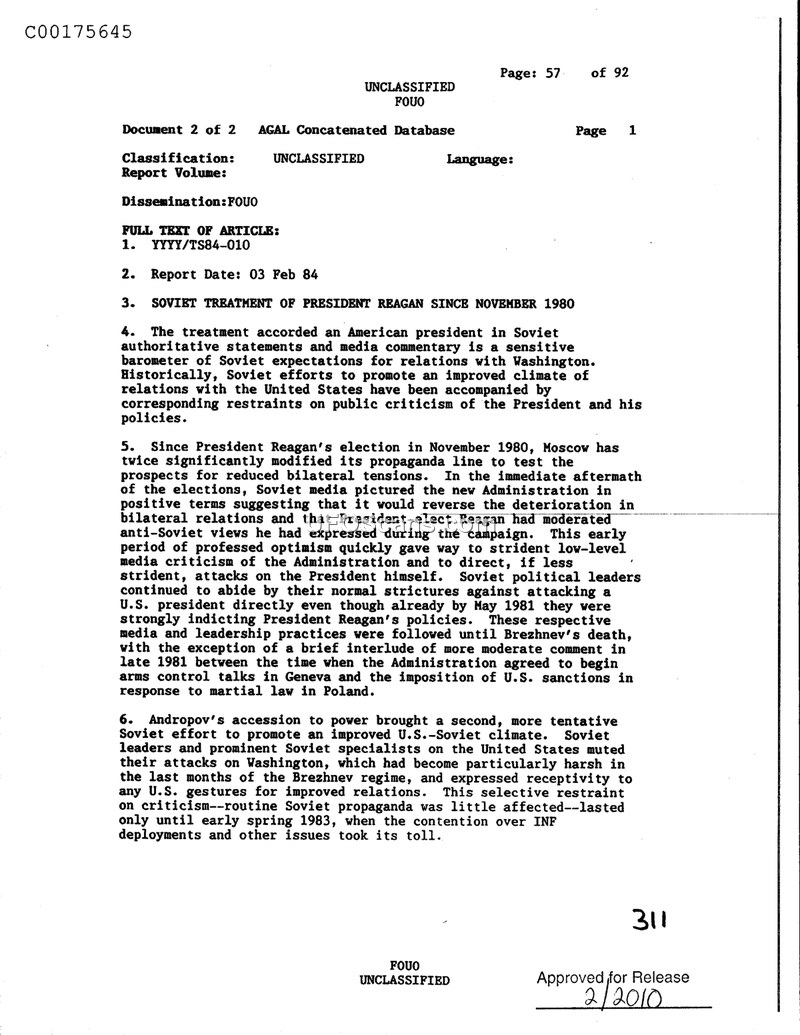
Rendered preview of the original document image. Download original file
Official Assessment
Soviet treatment of the U.S. President serves as a barometer for bilateral relations. Moscow has twice attempted to moderate its propaganda line to improve relations, first following Reagan's election and later following Andropov's accession to power, but both efforts were eventually curtailed by policy disagreements and international tensions.
Key Persons
- Ronald ReaganPresident of the United States
- BrezhnevSoviet leader
- AndropovSoviet leader