Declassified UFO / UAP Document
Soviet Public Treatment of President Reagan

Ever wanted to host your own late-night paranormal radio show?
Across the Airwaves
You're on the air. Callers bring Mothman, Fresno Nightcrawlers, UFO sightings, reptilian autopsies, and whispers about AATIP and Project Blue Book. Every reply shapes how the night goes.

AI-Generated Summary
This document analyzes the evolution of Soviet media and political rhetoric toward President Reagan from 1980 to 1984. It concludes that Soviet criticism of the President serves as a reliable indicator of the perceived state of U.S.-Soviet relations.
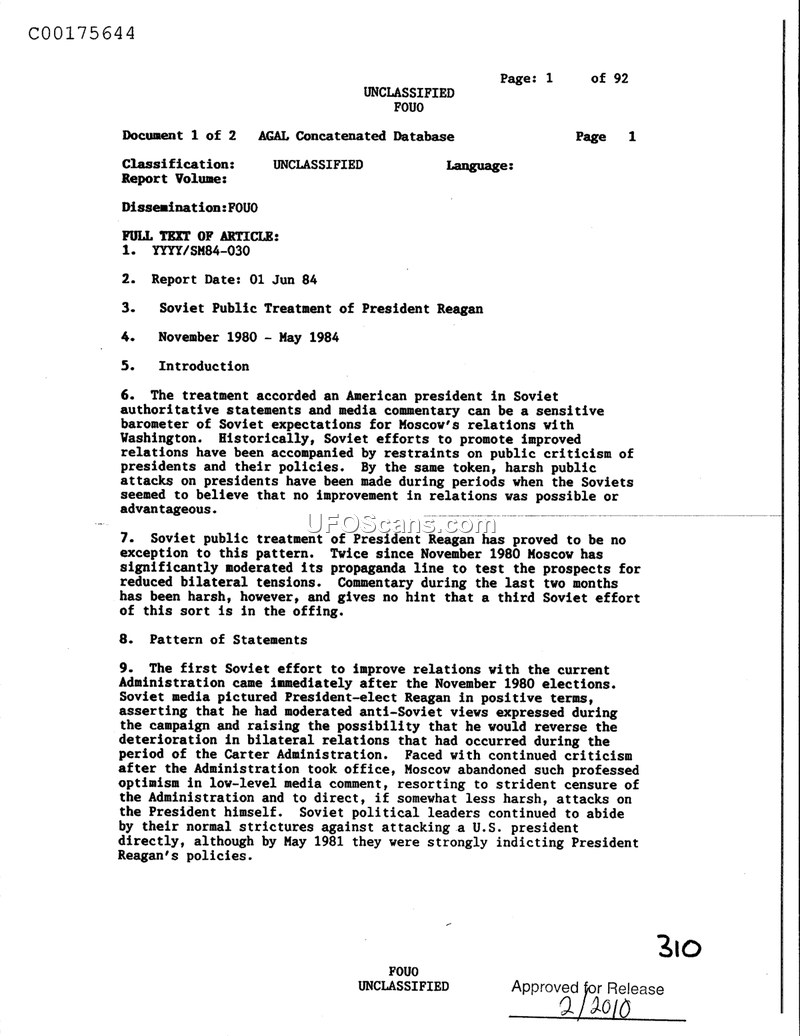
This intelligence assessment, dated June 1, 1984, examines the patterns of Soviet public rhetoric regarding President Ronald Reagan between November 1980 and May 1984. The document posits that the tone of Soviet authoritative statements and media commentary functions as a sensitive indicator of the state of relations between Moscow and Washington. Historically, the Soviet Union has exercised restraint in criticizing U.S. presidents when they perceived potential for improved relations, while resorting to harsh attacks when they believed no such improvement was possible. The report observes that the treatment of President Reagan followed this established pattern. Following the November 1980 elections, Soviet media initially portrayed the President-elect in a positive light, suggesting he might reverse the deterioration of relations that occurred during the Carter Administration. However, this optimism was short-lived. Once the Reagan Administration took office, Moscow shifted its stance, moving from low-level commentary to strident censure. By May 1981, Soviet political leaders were actively and strongly indicting the President's policies. The document concludes that the harsh commentary observed in the two months prior to the report's issuance provided no indication that a third Soviet effort to improve bilateral relations was forthcoming.
The treatment accorded an American president in Soviet authoritative statements and media commentary can be a sensitive barometer of Soviet expectations for Moscow's relations with Washington.
Rendered preview of the original document image. Download original file
Official Assessment
The document asserts that Soviet public treatment of U.S. Presidents serves as a barometer for bilateral relations. It notes that Moscow initially viewed President Reagan positively following the 1980 election, but shifted to harsh criticism after the Administration took office, eventually leading to strong indictments of his policies by May 1981.
Key Persons
- Ronald ReaganPresident of the United States
- Jimmy CarterFormer President of the United States