Declassified UFO / UAP Document
Thermoplane Flight Testing Highlighted

Ever wanted to host your own late-night paranormal radio show?
Across the Airwaves
You're on the air. Callers bring Mothman, Fresno Nightcrawlers, UFO sightings, reptilian autopsies, and whispers about AATIP and Project Blue Book. Every reply shapes how the night goes.

AI-Generated Summary
The document reports on the development of a heavy-lift 'thermoplane' aircraft in Russia designed for Siberian logistics. It clarifies that the project is an aerostatic transport program managed by the Termoplan Design Bureau.
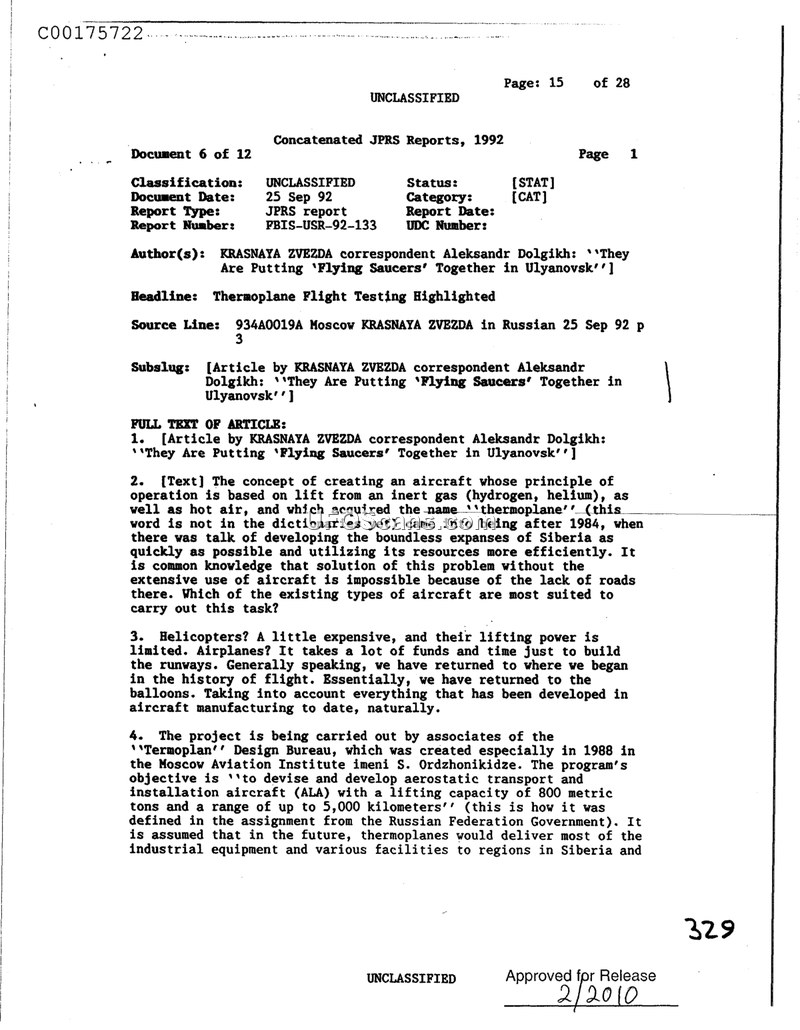
This document, a 1992 JPRS report, details the development of a specialized aircraft known as a 'thermoplane' in Ulyanovsk, Russia. The concept, which emerged around 1984, utilizes a combination of inert gases (hydrogen or helium) and hot air to generate lift. The project is managed by the 'Termoplan' Design Bureau, which was founded in 1988 at the Moscow Aviation Institute imeni S. Ordzhonikidze. The primary objective of this program, as defined by the Russian Federation Government, is to create an aerostatic transport and installation aircraft (ALA) capable of carrying 800 metric tons of cargo with a range of up to 5,000 kilometers. The development of this technology is intended to solve significant logistical and transportation problems in the remote regions of Siberia, where the lack of traditional road infrastructure makes conventional aircraft operations inefficient or impossible.
The concept of creating an aircraft whose principle of operation is based on lift from an inert gas (hydrogen, helium), as well as hot air, and which acquired the name ''thermoplane''
Rendered preview of the original document image. Download original file
Official Assessment
The Termoplan Design Bureau, established in 1988 at the Moscow Aviation Institute, is developing a large-scale aerostatic transport aircraft (ALA) to address logistical challenges in Siberia.
Key Persons
- Aleksandr DolgikhKRASNAYA ZVEZDA correspondent