Declassified UFO / UAP Document
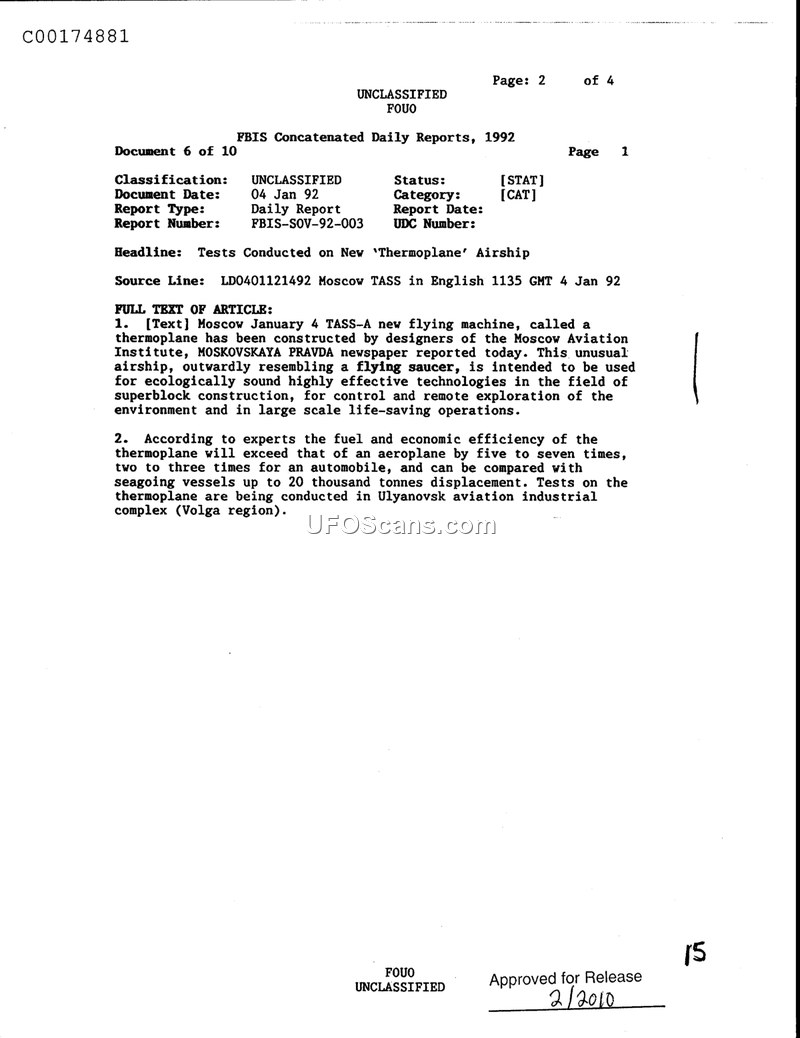
Tests Conducted on New 'Thermoplane' Airship

Ever wanted to host your own late-night paranormal radio show?
Across the Airwaves
You're on the air. Callers bring Mothman, Fresno Nightcrawlers, UFO sightings, reptilian autopsies, and whispers about AATIP and Project Blue Book. Every reply shapes how the night goes.

AI-Generated Summary
This document reports on the 1992 development of a 'thermoplane' airship by the Moscow Aviation Institute. The craft is noted for its saucer-like appearance and high projected fuel efficiency for use in remote exploration and rescue operations.
This document is a Foreign Broadcast Information Service (FBIS) daily report from January 4, 1992, detailing the development of a new Soviet-era aircraft known as a 'thermoplane.' According to a report from TASS and the newspaper MOSKAVAYA PRAVDA, designers at the Moscow Aviation Institute created this machine, which is described as having an outward appearance resembling a 'flying saucer.' The primary intended applications for the thermoplane include remote environmental exploration and large-scale life-saving operations. The report highlights the craft's projected economic and fuel efficiency, claiming it will be five to seven times more efficient than a standard aeroplane and two to three times more efficient than an automobile. Furthermore, the document notes that the thermoplane's capacity can be compared to seagoing vessels with a displacement of up to 20,000 tonnes. At the time of the report, testing of the thermoplane was being conducted at the Ulyanovsk aviation industrial complex in the Volga region.
This unusual airship, outwardly resembling a flying saucer, is intended to be used for ecologically sound highly effective technologies in the field of superblock construction, for control and remote exploration of the environment and in large scale life-saving operations.
Rendered preview of the original document image. Download original file
Official Assessment
Designers at the Moscow Aviation Institute have constructed a new flying machine called a thermoplane. The craft is intended for remote environmental exploration and life-saving operations. It is reported to be five to seven times more fuel and economically efficient than an aeroplane and two to three times more efficient than an automobile. Testing is currently underway at the Ulyanovsk aviation industrial complex.