Declassified UFO / UAP Document
Concatenated JPRS Reports, 1991
Ever wanted to host your own late-night paranormal radio show?
Across the Airwaves
You're on the air. Callers bring Mothman, Fresno Nightcrawlers, UFO sightings, reptilian autopsies, and whispers about AATIP and Project Blue Book. Every reply shapes how the night goes.

AI-Generated Summary
This 1991 JPRS report evaluates the first thirty years of human spaceflight. It concludes that while significant operational milestones were reached, manned missions have yet to provide fundamentally new scientific information beyond physiological and systems data.
This document is an excerpt from a 1991 JPRS report summarizing the progress of the space program thirty years after the first human spaceflight. The text, attributed to one of the world's first cosmonauts, evaluates the practical achievements of manned space exploration. It highlights that humans have successfully lived and worked in orbit for a year and have completed six lunar missions. However, the author notes that human mobility in open space remains limited and that human capabilities are largely dictated by onboard equipment, which often outperforms humans in precision tasks. The report concludes that, aside from gathering data on human physiology in weightlessness and the performance of flight systems, manned spaceflight has not yet provided fundamentally new scientific information, leaving the future of space exploration to be powered by hope for future substantive discoveries.
Manned spaceflight has not given us any fundamentally new information (other than data on man himself in weightlessness and data on the operation of the flight systems themselves in space), and we are powered by the hope for now that we will be able to do something of substance in the future.
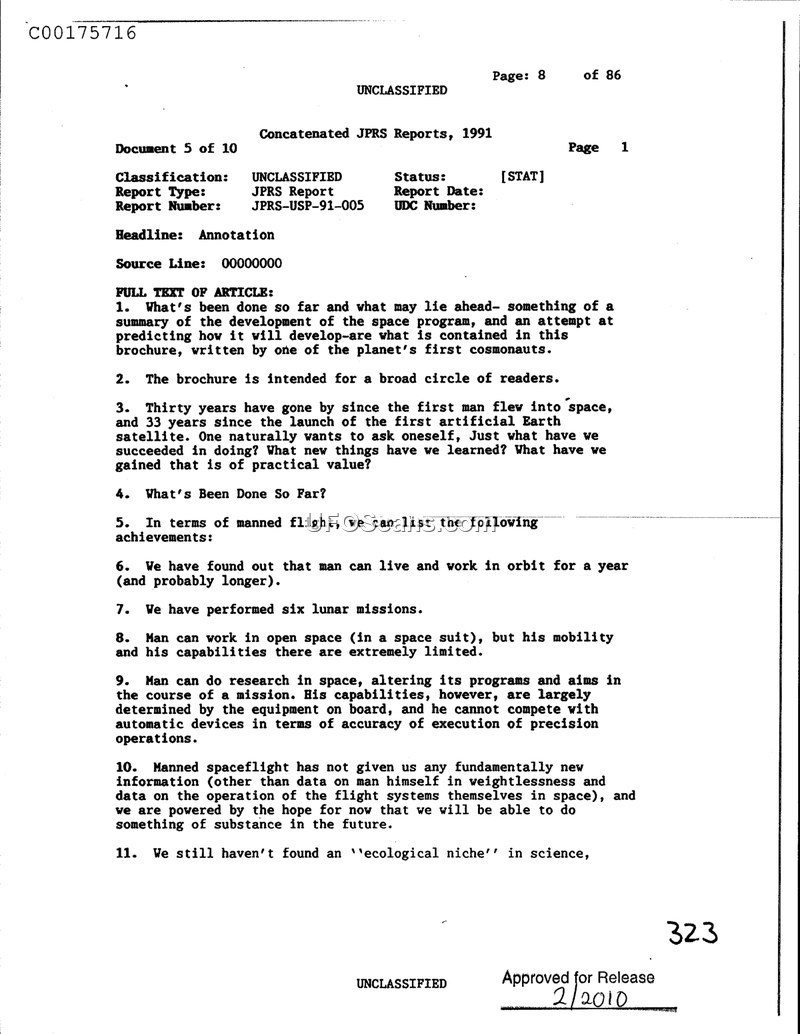
Rendered preview of the original document image. Download original file
Official Assessment
The document provides a retrospective assessment of thirty years of human spaceflight, noting that while humans can survive in orbit for a year and perform lunar missions, their capabilities in space are limited by onboard equipment. It concludes that manned spaceflight has not yielded fundamentally new information beyond data on human weightlessness and flight systems.
Key Persons
- one of the planet's first cosmonautsAuthor of the brochure