Declassified UFO / UAP Document
Boundaries of Cosmology

Ever wanted to host your own late-night paranormal radio show?
Across the Airwaves
You're on the air. Callers bring Mothman, Fresno Nightcrawlers, UFO sightings, reptilian autopsies, and whispers about AATIP and Project Blue Book. Every reply shapes how the night goes.

AI-Generated Summary
This 1990 JPRS report features an article by Soviet scientist Leonid Grishchuk criticizing the historical and contemporary state of Soviet scientific policy. It highlights the negative impact of utilitarian funding models on basic research and the need for a cultural shift to support scientific advancement.
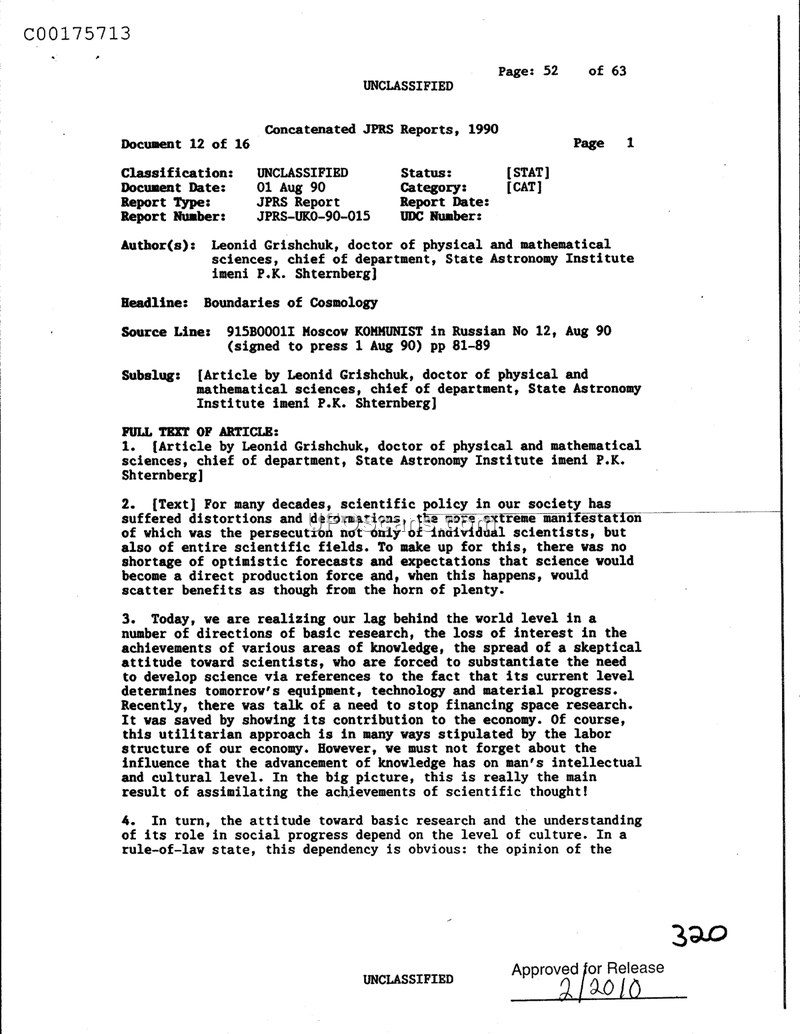
This document is a JPRS report dated August 1, 1990, containing an article titled 'Boundaries of Cosmology' by Leonid Grishchuk, a doctor of physical and mathematical sciences at the State Astronomy Institute imeni P.K. Shternberg. The text provides a critique of Soviet scientific policy, noting that for decades, the field suffered from distortions and the persecution of individual scientists and entire scientific disciplines. Grishchuk observes that there was a historical reliance on optimistic forecasts regarding science as a direct production force. He argues that the Soviet Union is currently lagging behind global standards in basic research. He expresses concern over a loss of interest in scientific achievements and a skeptical attitude toward scientists, who are frequently required to justify their work through immediate economic utility. Grishchuk contends that while this utilitarian approach is a product of the existing labor structure, it ignores the vital role that the advancement of knowledge plays in intellectual and cultural development. He concludes by emphasizing that the societal attitude toward basic research and its role in progress is fundamentally tied to the overall level of culture in a rule-of-law state.
For many decades, scientific policy in our society has suffered distortions and deformations, the more extreme manifestation of which was the persecution not only of individual scientists, but also of entire scientific fields.
Rendered preview of the original document image. Download original file
Official Assessment
The author argues that Soviet scientific policy has historically suffered from distortions, including the persecution of scientists and fields of study. He highlights a current lag in basic research and criticizes the utilitarian approach to funding science, which prioritizes immediate economic contributions over the long-term intellectual and cultural benefits of scientific advancement.
Key Persons
- Leonid GrishchukAuthor, doctor of physical and mathematical sciences, chief of department