Declassified UFO / UAP Document
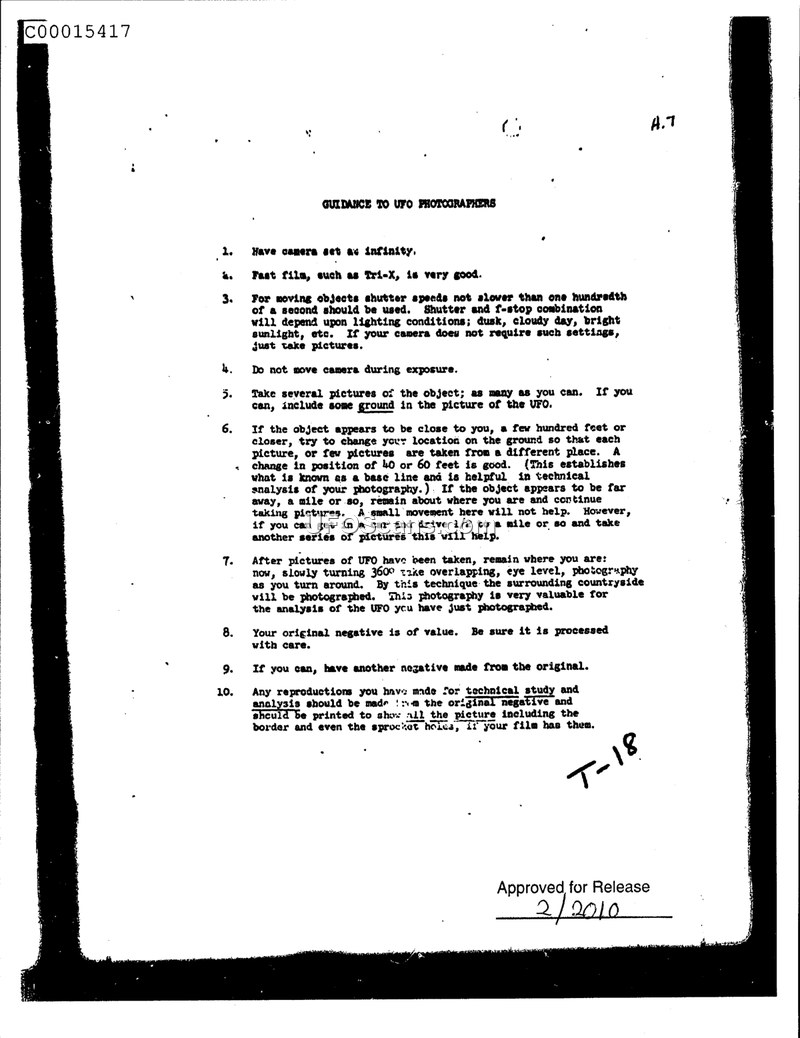
GUIDANCE TO UFO PHOTOGRAPHERS
Ever wanted to host your own late-night paranormal radio show?
Across the Airwaves
You're on the air. Callers bring Mothman, Fresno Nightcrawlers, UFO sightings, reptilian autopsies, and whispers about AATIP and Project Blue Book. Every reply shapes how the night goes.

AI-Generated Summary
This document provides official technical instructions for photographing UFOs to ensure the resulting images are useful for analysis. It covers camera settings, film selection, and procedures for capturing ground references and surrounding terrain.
This document, titled 'GUIDANCE TO UFO PHOTOGRAPHERS,' serves as a technical instructional guide for individuals who may encounter and attempt to photograph unidentified aerial phenomena. The text outlines ten specific recommendations to ensure that any resulting imagery is of sufficient quality for subsequent technical analysis. The instructions cover fundamental photographic practices, such as setting the camera to infinity and utilizing fast film, specifically citing Tri-X as an example. Regarding the mechanics of capturing moving objects, the guide advises using shutter speeds no slower than one-hundredth of a second, noting that the specific shutter and f-stop combination should be adjusted based on prevailing lighting conditions, such as dusk, cloudy days, or bright sunlight. The document emphasizes the importance of stability, explicitly warning against moving the camera during exposure. It encourages the capture of multiple images and suggests including ground references to assist in later analysis. For objects appearing close, the guide recommends changing the photographer's location by 40 to 60 feet between shots to establish a baseline. If the object is distant, the photographer is advised to remain stationary or, if possible, to drive a half-mile or more to capture a new series of images from a different perspective. Furthermore, the document instructs the photographer to perform a 360-degree rotation after the initial event to capture the surrounding landscape, which is deemed valuable for contextual analysis. Finally, the guide stresses the preservation of original negatives, recommending they be processed with care and that reproductions for technical study be printed to include the entire frame, including borders and sprocket holes.
Any reproductions you have made for technical study and analysis should be made from the original negative and should be printed to show all the picture including the border and even the sprocket holes, if your film has them.
Rendered preview of the original document image. Download original file
Official Assessment
The document provides ten specific technical instructions for individuals attempting to photograph UFOs, emphasizing camera settings, film type, movement, and the importance of preserving original negatives for technical analysis.