Declassified UFO / UAP Document
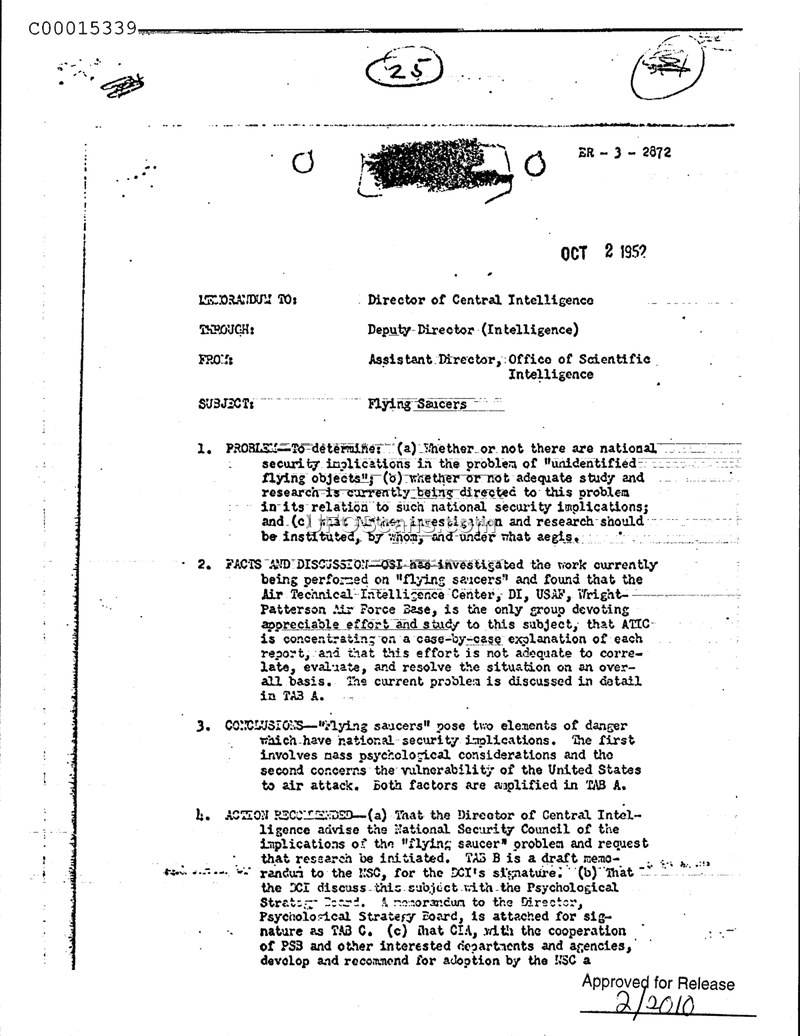
Memorandum: Flying Saucers

Ever wanted to host your own late-night paranormal radio show?
Across the Airwaves
You're on the air. Callers bring Mothman, Fresno Nightcrawlers, UFO sightings, reptilian autopsies, and whispers about AATIP and Project Blue Book. Every reply shapes how the night goes.

AI-Generated Summary
This 1952 CIA memorandum identifies 'flying saucers' as a national security concern due to potential psychological impacts and vulnerabilities to air attack. It criticizes the existing Air Force investigation process as inadequate and recommends a broader, inter-agency research effort.
This memorandum, dated October 2, 1952, was addressed to the Director of Central Intelligence from the Assistant Director of the Office of Scientific Intelligence (OSI). The document outlines the OSI's assessment of the 'flying saucer' phenomenon and its implications for national security. The OSI reports that, at the time, the Air Technical Intelligence Center (ATIC) at Wright-Patterson Air Force Base was the sole organization dedicated to investigating these reports. However, the OSI concluded that the ATIC's current methodology—focusing on individual, case-by-case explanations—was inadequate for addressing the broader national security concerns. The document identifies two primary dangers: the potential for mass psychological issues and the vulnerability of the United States to air attack. To address these concerns, the OSI recommended that the Director of Central Intelligence advise the National Security Council to initiate further research, engage in discussions with the Psychological Strategy Board, and work with other relevant departments to develop a comprehensive approach to the subject.
Flying saucers pose two elements of danger which have national security implications. The first involves mass psychological considerations and the second concerns the vulnerability of the United States to air attack.
Rendered preview of the original document image. Download original file
Official Assessment
Flying saucers pose two elements of danger which have national security implications. The first involves mass psychological considerations and the second concerns the vulnerability of the United States to air attack.
The Office of Scientific Intelligence determined that the Air Technical Intelligence Center at Wright-Patterson Air Force Base was the only group studying the phenomenon, but their case-by-case approach was insufficient for a comprehensive evaluation.