Declassified UFO / UAP Document
FCC Monitoring and Flying Saucers
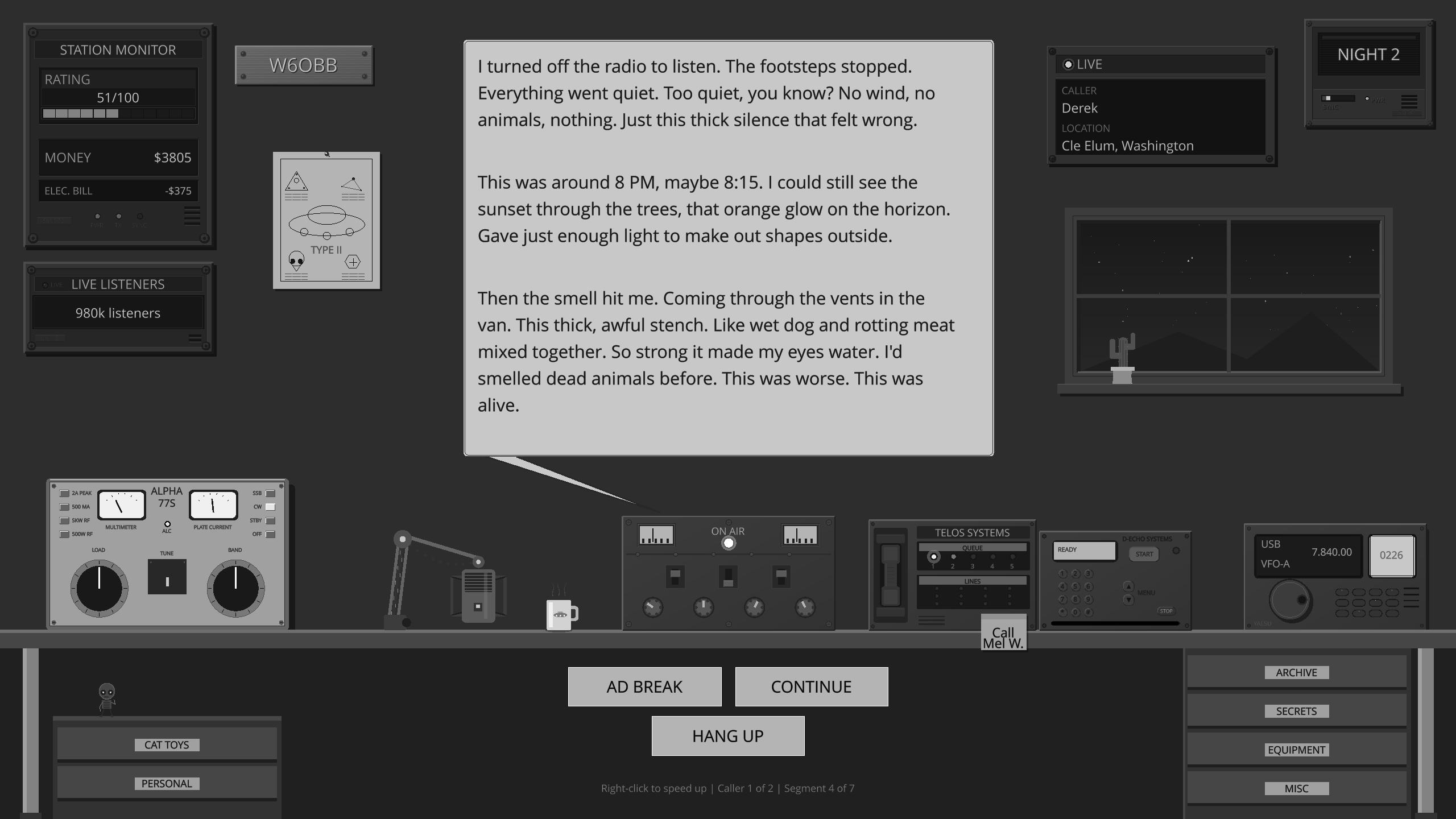
Ever wanted to host your own late-night paranormal radio show?
Across the Airwaves
You're on the air. Callers bring Mothman, Fresno Nightcrawlers, UFO sightings, reptilian autopsies, and whispers about AATIP and Project Blue Book. Every reply shapes how the night goes.

AI-Generated Summary
A 1952 secret memorandum confirms that the FCC had no record of radio signals linked to UFOs. It outlines the technical limitations of the FCC's monitoring network at the time.
This memorandum, dated 9 December 1952, documents an inquiry made by E. U. Graham to the Field Engineering and Monitoring Division of the Federal Communications Commission (FCC) regarding potential radio signals associated with unidentified flying saucers. Graham interviewed Mr. Irving Weston of the FCC to determine if the Commission possessed any knowledge of such signals. Mr. Weston confirmed that the FCC had no such knowledge. The document explains the operational limitations of the FCC's monitoring network, which consisted of 12 full-time and 6 part-time stations located in the United States, Alaska, and Hawaii. These stations were primarily tasked with specific assignments and had limited capacity for general spectrum monitoring. Furthermore, their equipment was largely restricted to frequencies below 200 mc/s, making the detection of signals above 30 mc/s difficult unless they were in the immediate vicinity of a transmitter. The memorandum notes that the FCC maintained a historical file of reported intercepts at the Briggs Building, which dated back three or four years and was used to assist in the identification of new signals. The discussion was classified as Secret.
I interviewed Mr. Irving Weston of the Field Engineering and Monitoring Division of the FCC to determine whether the Commission at present has any knowledge of unexplained radio signals which might possibly be connected with unidentified flying saucers. His answer was no.
PDF not loading? Download the PDF directly
Official Assessment
The FCC has no knowledge of unexplained radio signals that might be connected with unidentified flying saucers.
The FCC maintains 12 full-time and 6 part-time monitoring stations, primarily in the US, Alaska, and Hawaii. Their equipment is generally limited to frequencies below 200 mc/s and is focused on specific assignments rather than general spectrum cruising. The FCC maintains a file of reported intercepts in the Briggs Building.
Key Persons
- Irving WestonField Engineering and Monitoring Division of the FCC