Declassified UFO / UAP Document
Food Rationing, Supply Situation Viewed

Ever wanted to host your own late-night paranormal radio show?
Across the Airwaves
You're on the air. Callers bring Mothman, Fresno Nightcrawlers, UFO sightings, reptilian autopsies, and whispers about AATIP and Project Blue Book. Every reply shapes how the night goes.

AI-Generated Summary
This FBIS report from November 1991 details the severe food supply crisis in the Soviet Union. It highlights how collective and state farms were bypassing state procurement in favor of more profitable private trade, leading to widespread shortages and rationing.
This document, a 1991 report from the Foreign Broadcast Information Service (FBIS), provides an economic analysis of the food supply situation in the Soviet Union as the country approached winter. Written by Candidate of Economic Sciences L. Vashchukov and originally published in the newspaper PRAVDA on November 22, 1991, the text details the growing scarcity of essential food items such as meat, butter, and vegetables. The author observes that the disappearance of these goods from retail stores has led to the implementation of rationing in various cities, a situation described as reminiscent of a blockade. The report relies on statistical data to explain the crisis, specifically focusing on the grain procurement system. Despite a harvest that produced sufficient goods, the state granaries were significantly under-supplied, having received only 39 million tonnes of grain compared to 66 million tonnes during the same period the previous year. Vashchukov identifies the primary cause of this discrepancy as the reluctance of collective farms (kolkhozes) and state farms (sovkhozes) to sell their grain to the state at fixed prices. Instead, these entities were opting to barter or sell their produce to private stockbrokers who offered prices up to ten times higher than the state-mandated rates. The report concludes by noting a significant deficit in feed grain, with only 25-27 million tonnes procured against a requirement of 48 million tonnes, highlighting the systemic economic instability facing the nation at that time.
Some cities are introducing rationing on sales of bread, reminiscent of a blockade.
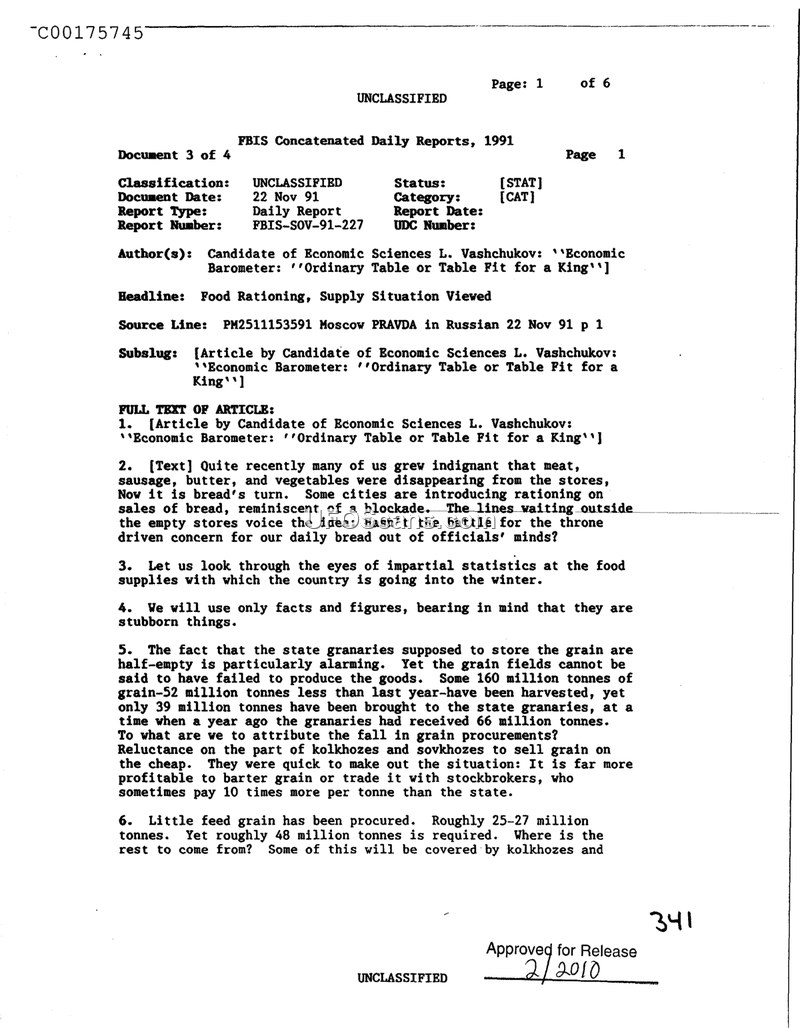
Rendered preview of the original document image. Download original file
Official Assessment
The author highlights a severe food supply crisis in the Soviet Union, noting that essential goods like meat, butter, and vegetables are disappearing from stores. Rationing is being introduced in some cities, which the author compares to a blockade. Statistical analysis reveals that while grain production was sufficient, state granaries received only 39 million tonnes compared to 66 million tonnes the previous year. This shortfall is attributed to kolkhozes and sovkhozes preferring to barter or sell grain to private stockbrokers for higher prices rather than to the state.
Key Persons
- L. VashchukovCandidate of Economic Sciences and author of the article