Declassified UFO / UAP Document
Possibilities of Military Coup Assessed
Ever wanted to host your own late-night paranormal radio show?
Across the Airwaves
You're on the air. Callers bring Mothman, Fresno Nightcrawlers, UFO sightings, reptilian autopsies, and whispers about AATIP and Project Blue Book. Every reply shapes how the night goes.
AI-Generated Summary
A 1990 FBIS report from LITERATURNAYA GAZETA discusses Soviet social instability. It references UFO sightings as a symptom of mass hysteria during a period of economic crisis.
This document is a translation of an article by Vladimir Sokolov, an editor for LITERATURNAYA GAZETA, published on September 12, 1990. The article, titled 'Possibilities of Military Coup Assessed,' discusses the socio-political climate in the Soviet Union during a time of significant economic instability. Sokolov argues that the country's persistent shortages of goods have led to an outbreak of mass belief in 'something special' or irrational phenomena. He cites the public's hope for investigators Gdlyan and Ivanov to arrest the Politburo, the popularity of television miracle-workers Chumak and Kashpirovskiy, and the occurrence of UFO landings as examples of this collective psychological state. The author uses these examples to illustrate how the populace, disillusioned by the failure of political programs to improve their daily lives, turned toward fringe beliefs and messianic figures. The mention of UFOs is strictly contextual, serving as a rhetorical device to highlight the atmosphere of desperation and irrationality in the late Soviet period.
The salt and vegetable oil panic was accompanied by UFO landings everywhere.
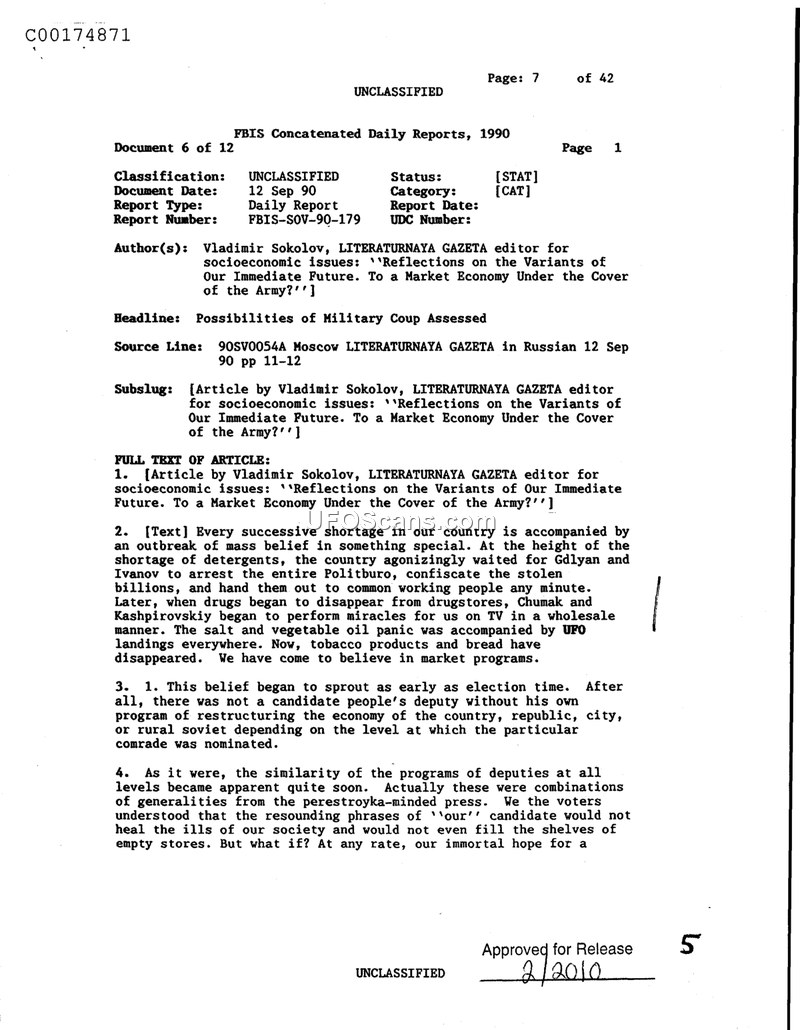
Rendered preview of the original document image. Download original file
Official Assessment
The author uses the mention of UFO sightings as a cultural metaphor for the mass hysteria and irrational beliefs that emerged in the Soviet Union during periods of economic hardship and shortages.
Key Persons
- GdlyanInvestigator/Public figure
- IvanovInvestigator/Public figure
- ChumakPublic figure/Performer
- KashpirovskiyPublic figure/Performer