Declassified UFO / UAP Document
Panel Assessment of Unidentified Aerial Phenomena Sightings
Ever wanted to host your own late-night paranormal radio show?
Across the Airwaves
You're on the air. Callers bring Mothman, Fresno Nightcrawlers, UFO sightings, reptilian autopsies, and whispers about AATIP and Project Blue Book. Every reply shapes how the night goes.

AI-Generated Summary
This document summarizes a panel's review of various UAP sightings from 1950-1952, concluding that most cases lacked sufficient data and that further investigation into every report was an inefficient use of resources.
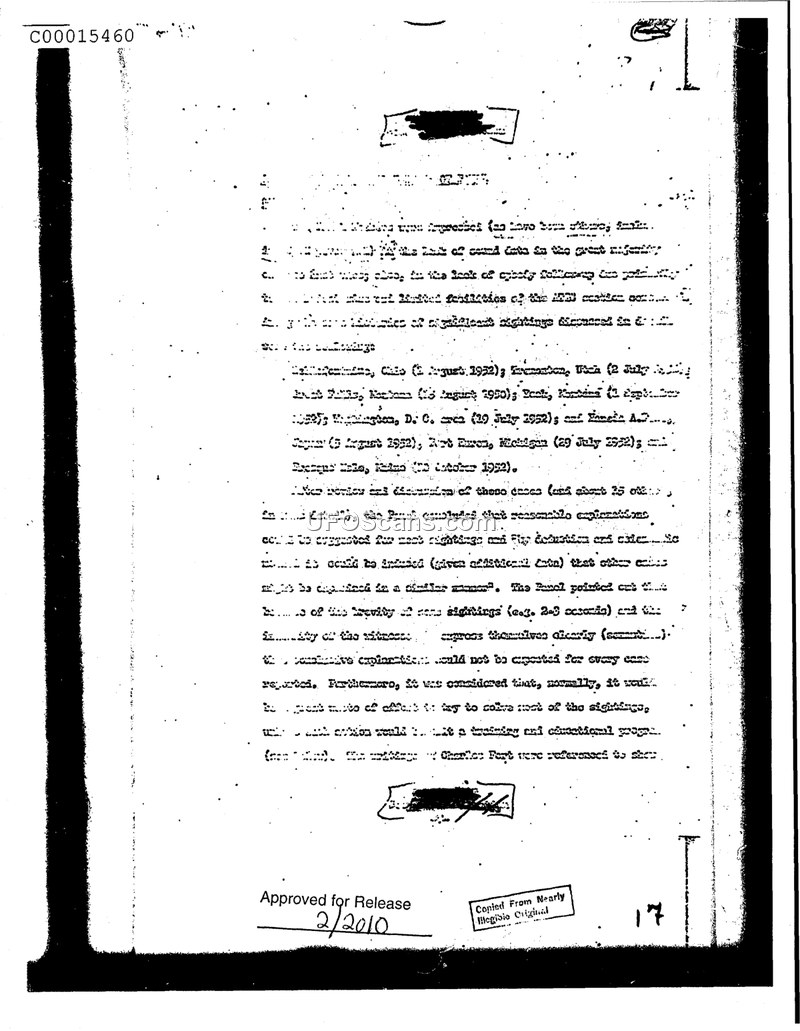
This document provides an assessment by a panel regarding various unidentified aerial phenomena sightings reported between 1950 and 1952. The panel reviewed specific incidents, including sightings in Valparaiso, Chile (August 1952); Tremonton, Utah (July 1952); Great Falls, Montana (August 1950); Yack, Montana (September 1952); Washington, D.C. (July 1952); Haneda A.F.B., Japan (August 1952); Fort Huron, Michigan (July 1952); and Presque Isle, Maine (October 1952). The panel concluded that there was a significant lack of sound data for the majority of these cases, compounded by a lack of follow-up and limited facilities for investigation. They determined that reasonable explanations could be provided for most sightings and suggested that additional data would likely explain the remaining cases. The panel noted that the brevity of many sightings, sometimes lasting only two to three seconds, made it difficult for witnesses to provide clear accounts. Ultimately, the panel advised that attempting to solve every reported sighting would be an inefficient use of resources unless it served a broader training or educational purpose. The writings of Charles Fort were referenced during the panel's deliberations.
The Panel pointed out that the brevity of some sightings (e.g. 2-3 seconds) and the inability of the witnesses to express themselves clearly (somewhat...) that a conclusive explanation could not be expected for every case reported.
Rendered preview of the original document image. Download original file
Official Assessment
The Panel concluded that reasonable explanations could be suggested for most sightings and that it could be induced (given additional data) that other cases might be explained in a similar manner.
The Panel identified a lack of sound data in the majority of cases and noted that the brevity of some sightings (e.g., 2-3 seconds) hindered clear reporting. They suggested that further efforts to solve every sighting would be a waste of effort unless such action supported a training and educational program.
Key Persons
- Charles FortAuthor whose writings were referenced