Declassified UFO / UAP Document
Incident #141 — Hecla, South Dakota — 30 June 1948
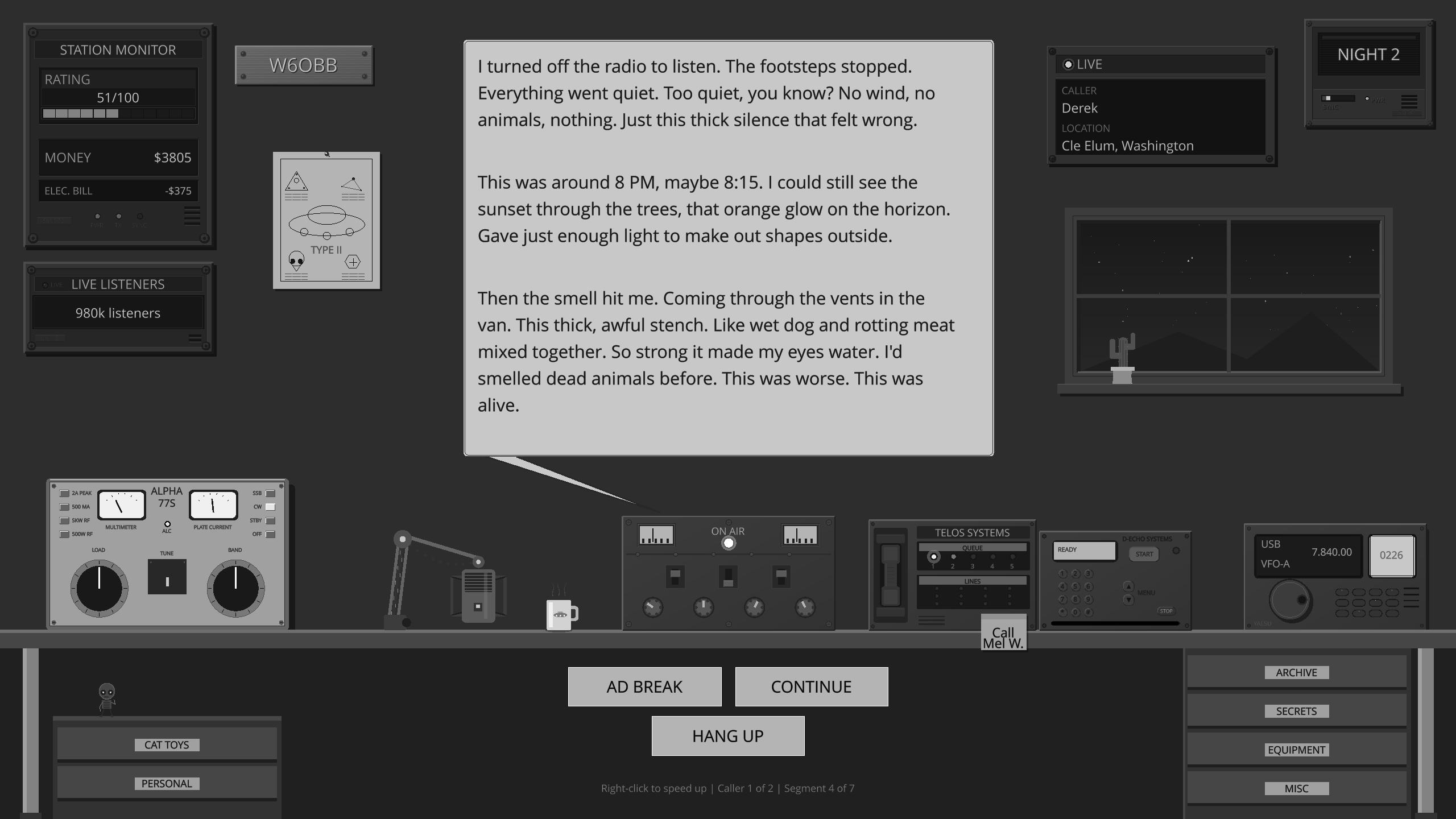
Ever wanted to host your own late-night paranormal radio show?
Across the Airwaves
You're on the air. Callers bring Mothman, Fresno Nightcrawlers, UFO sightings, reptilian autopsies, and whispers about AATIP and Project Blue Book. Every reply shapes how the night goes.

AI-Generated Summary
A chemical engineer reported a stationary, round, metallic object that disintegrated over South Dakota on 30 June 1948. Air Force investigators concluded the object was likely a cluster of balloons carrying scientific equipment.
This document details the investigation of an unusual atmospheric phenomenon reported on 30 June 1948 by a chemical engineer and amateur astronomer traveling near Hecla, South Dakota. The witness, while driving on Route 81 between Watertown and Webster, observed a stationary, round, polished aluminum object at approximately 11:25. The object remained visible for over two hours, during which time the witness made several observations. The object eventually disintegrated, with parts forming an inverted isometric triangle before fading from view. The witness and his wife provided detailed accounts of the object's appearance, noting that it seemed to be a cluster of parts rather than a single solid mass. The report includes correspondence between the U.S. Coast Guard and the U.S. Air Force's Air Materiel Command, documenting the referral of the sighting for official evaluation. Air Force investigators, including Captain M. Martin, interviewed the witness and his wife in July 1948, noting their sincerity and the intensity of their interest. The final assessment, included in the Project Grudge report, concludes that the object was likely a cluster of balloons, possibly carrying cosmic ray apparatus, which would explain the starlike appearance and the subsequent disintegration. The document also contains sketches of the object's configuration during the break-up and a map of the sighting area.
In all probability the object was a cluster of balloons, carrying, perhaps, cosmic ray apparatus. This would account for the starlike appearance and the eventual breaking up into parts.
PDF not loading? Download the PDF directly
Official Assessment
In all probability the object was a cluster of balloons, carrying, perhaps, cosmic ray apparatus. This would account for the starlike appearance and the eventual breaking up into parts.
The object was determined not to be a star or astronomical body, but likely a cluster of balloons.
Witnesses
Key Persons
- R. G. WillochCoast Guard officer by direction
- S. Y. HammondLCDR, USCG, Chief, Intelligence & Law Enforcement Division